
What the New Texas Hemp Manufacturing Rules Really Mean

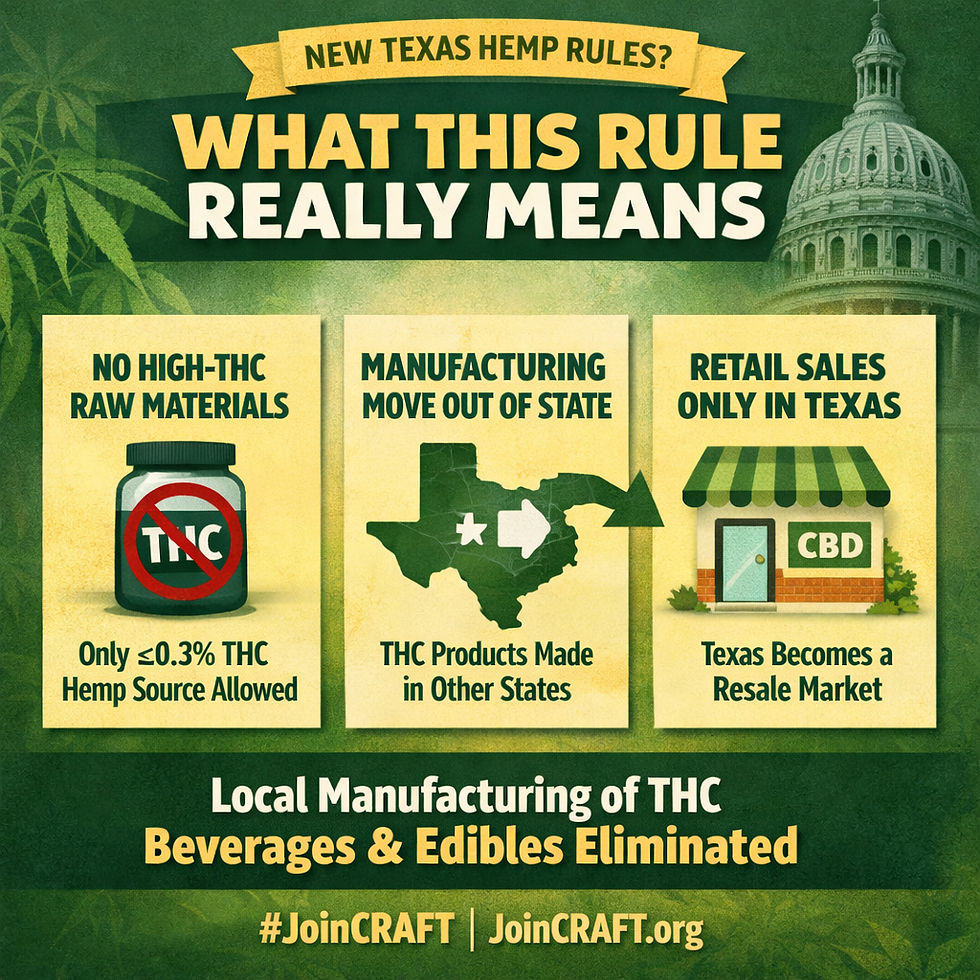
A closer look at how raw material requirements could reshape the entire industry
The recently adopted Texas Department of State Health Services (DSHS) rules under 25 TAC Chapter 300 introduce sweeping regulatory changes for the manufacture, distribution, and retail sale of consumable hemp products in Texas.
Much of the discussion around these rules has focused on specific product categories — particularly smokable hemp and intoxicating THC products. However, when reading the rules closely, a deeper structural issue emerges that could have far broader implications for the industry.
The key lies in how the rules regulate raw materials and manufacturing inputs.
The Critical Requirement: Raw Hemp Must Already Be Compliant
The rules require that hemp plants used in manufacturing must be tested prior to processing and meet the federal definition of hemp:
Before a hemp plant is processed or otherwise used in the manufacture of a consumable hemp product, a representative sample must be tested and show a total delta-9 THC concentration of 0.3% or less on a dry weight basis.
This means that the plant material itself must already fall within the legal hemp limit before it enters the manufacturing process.
At first glance, this appears consistent with federal hemp law. However, the implications become more complex when examining how modern cannabinoid manufacturing actually works.
Restrictions on High-THC Inputs
Another section of the rules further restricts what materials may be used in Texas manufacturing:
Substances containing total delta-9 THC levels above the acceptable hemp THC level may not be transported into Texas for further processing within Texas.
This provision effectively prevents manufacturers from importing higher-THC intermediate materials for further processing into compliant finished products.
In practical terms, it means that all ingredients entering a Texas manufacturing facility must already meet hemp THC limits.
The Manufacturing Reality
Many hemp-derived cannabinoid products are created through a process where:
Cannabinoids are extracted or concentrated.
Those ingredients are then diluted or formulated into finished products.
The final product meets the legal THC threshold.
Under the new Texas rules, however, the regulatory framework focuses heavily on the THC content of the input materials, not just the final product.
Because of this, manufacturers may face significant limitations when attempting to produce certain cannabinoid products inside the state.
Why Some Believe Edibles and Beverages Are “Safe”
Some industry discussions suggest that intoxicating hemp beverages or edible products remain unaffected because the finished product must still test below the legal THC limit.
The rules do allow finished products that meet the hemp definition.
However, the practical challenge arises earlier in the process — at the ingredient level.
If the raw materials used to formulate those products exceed hemp THC thresholds, they may not be permitted for manufacturing within Texas under the current rule language.
Possible Industry Consequences
If interpreted and enforced as written, the rules could create several major shifts in the Texas hemp marketplace.
Manufacturing May Move Out of State
Because substances above hemp THC levels cannot be transported into Texas for processing, some companies may choose to manufacture products in other states and ship compliant finished goods into Texas.
Texas Could Become a Retail-Focused Market
While the rules regulate in-state manufacturing, they still allow products manufactured elsewhere to be sold in Texas if they meet federal hemp requirements and testing standards.
Increased Emphasis on Documentation and Compliance
The rules also significantly expand recordkeeping requirements, including:
Certificates of Analysis (COAs) for raw hemp and ingredients
Batch production records
Supplier documentation and traceability records
For businesses operating in Texas, maintaining strong compliance systems will become more important than ever.
The Need for Clear Regulatory Guidance
As these rules move toward implementation, the industry will likely need additional clarity from regulators on how these provisions will be interpreted in practice.
Questions remain about:
acceptable manufacturing inputs
interstate sourcing of ingredients
enforcement priorities
how finished product compliance will be evaluated
Clear guidance will be essential for businesses attempting to operate responsibly within the law.
Why Compliance Infrastructure Matters Now
Regardless of how these rules evolve, one reality is becoming clear:
The hemp industry is entering a new era of regulatory scrutiny.
Businesses that implement strong documentation systems, traceability procedures, and workforce training will be in the best position to navigate this environment.
At CRAFT (Cannabis Regulatory Alignment Framework & Training), our mission is to help businesses build the governance, documentation, and operational systems needed to operate safely and responsibly in highly regulated markets.
The future of this industry will depend not just on policy decisions — but on how well businesses demonstrate professional standards, transparency, and compliance readiness.
Stay informed. Stay compliant. Build the future responsibly.
Get compliant. Stay informed. Build the future responsibly.


Comments